Friday, October 30, 2009

Quilts: Pattern and Rhythm

The Nelson Art Gallery, located in UC Davis, currently is displaying many African American sewn quilts. Each quilt has its own unique pattern and design. Although all the quilts are different they all share two elements of design, pattern and rhythm.


http://eggheads.ucdavis.edu/tour/images/yin_yang.jpgds.ucdavis.edu/tour/images/yin_yang.jpg
Many of the quilt’s creators are unknown, and therefore untitled. One of these unknown quilts had a very simple pattern. The quilt had four sections and in each section one flower with six petals. The repetition of this image is considered pattern. Since the quilt has a repetition of shapes and color, the design is more attractive to the viewer. The flowers cause the viewer’s eyes to rotate around the quilt in stead of focusing on one focal point. Rhythm is another element utilized in this design to make the viewer’s eyes circulate around the quilt. The petals on the flowers are each facing in different directions; three petals curving to the left and three curving to the right. This technique adds a flow or rhythm to the design, just as different repeated notes add rhythm to music.

Another quilt that was displayed at the gallery was called, “Piano Keys” and created by Avis Collins Robinson, 2009. This particular quilt had much pattern and rhythm as well. It consisted of many vertical fabric strips of different lengths and colors. In fact, it only utilizes different shades of the primary colors; blue, red, and yellow. Each color occupies one third of the space and transitions into each other. This can be defined as pattern because of the pattern of the different shades of color and because of the pattern of the vertical lines and nature of the quilt. The quilts title, “Piano Keys” implies rhythm and the vertical patterns represent keys on a piano.

Therefore, quilts are often a perfect example of pattern and rhythm utilized in design.


Quilt By: Avis Collins Robinson
Title: Sharecropper's Masterpiece, 2008 (featured at the Nelson Art Gallery, UC Davis)
http://www.happenstand.com/images/upload/0/1879/1242788015_m.jpg

Tuesday, October 27, 2009

Scale and Proportion

Scale and proportion both contribute to size in design. They refer to size measured against other objects or images within the design.


A designer or artist can use these two elements of design for a few different reasons. First, the elements can be used to grab the viewer’s attention. For example, in the image to the left the tiny person hanging the frame is where are attention is directed. Although it is the smallest object in the photo, it stands out because it is used as positive space. The dark figure catches our attention against the large, white wall background.

Photograph By: Loan Nguyen
http://www.joshspear.com/wordpress/wp-content/uploads/2007/11/village.jpg

The designer also could be using the small figure to emphasis this particular part of the photo. Since our attention is directed to this particular spot; it must be important to the artist purpose of the piece.

Another reason for this change in proportion and scale is that it is unexpected. As humans we perceive the man hanging the picture to be normal size. However, the size of the wall is exaggerated to make the man smaller than we would recognize.

Therefore, the photographer utilized scale and proportion in many ways for different effects on the design and on the audience viewing the design.

Friday, October 23, 2009

Design with a Purpose

Design is created in a purposeful way. A designer generally, if not always, has a reason he or she is using the elements found in design. When a designer is in the thinking process of the creation, one of the questions they ask is, “What is the type of audience will be viewing my work?” The designer also needs to think about how they are going to please that audience with their design.

One way a design will catch the viewer’s attention is through a focal point. A focal point is the section of the design that stands out the most. This element can be achieved by utilizing color, size, and balance.

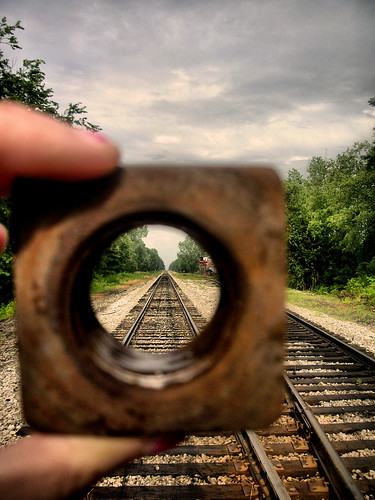
For example when you view the photo below, your eyes are clearly directed to the middle of the circle, right where the train tracks get to the point where you can no longer see it.


By Christy Bindas
http://farm2.static.flickr.com/1051/574379846_e79e059d3c.jpg

Another way to catch the viewer’s attention is through balance. The photo above achieves balance because of its horizontal axis. This axis separates the sky from the railroad.

The rusted nut that is being held up also grabs our attention. This object allows the photo to have balance. It is positive space that allows us to focus on the negative space, which draws our eye to the focal point.

Therefore, this photo wasn’t just taken without purpose. The artist clearly thought about all the elements that would capture a viewer’s attention.

In fact all railroad tracks we encounter will have a focal point and balance. Therefore, deign in our society also achieves to grab our attention.

Wednesday, October 21, 2009

Visual Perception in Design (Gestalt Theory)

When we look at design we look for meaning or unity. This psychology of our visual perception is defined as the gestalt theory.

Design can be perceived as two-dimensional or three-dimensional. However, no matter what the design is, it always will have unity between shape, color, size, or other elements of art. The viewer automatically attempts to find this unity and pattern when analyzing the piece of work.

For example, if a viewer is observing a two dimensional design that consists of two dots and a line, the viewer might connect the image to the image of a face, specifically a smiley face.

http://thesituationist.files.wordpress.com/2009/05/smiley-face.jpg

If a viewer observes a design that is three-dimensional that consisted of many lines crossing over each other, the viewer might connect the piece to an image of a triangles.

www.princetonol.com/.../high/Cyndi-sculpture.htm

The fact is that the viewer views things in a logical way. If the viewer cannot connect the design to any pattern, it will seem chaotic to the viewer. As a result of chaos the viewer may walk away from the design which is not supporting the designer.

Therefore, a designer must work to achieve unity in design so the viewer will be able to relate to the product. A designer may achieve unity through repetition, continuation, lines, positive and negative space, shape, size (scale), or color. The designer needs to find a balance between unity and variety, without losing the focal point of the design.

Tuesday, October 20, 2009

Unity and Variety


Design is defined by two characteristics: unity and variety. Both are found in most every design we view everyday. Unity is the relationship between similar elements of design. Variety is the relationship between different elements. Although these two characteristics seem to contradict each other they also work together.

When a design contains unity, it connects and organizes the design. Unity can be repeated images or elements through out the design. However, unity does not necessarily mean the repeating images or elements need to be identical. The main reason unity is important is so that the design does not seem random or without meaning.

When design contains variety, it makes the design more interesting. Variety can be a variation of any element in a design. For example, a designer could add variation to color, size, or shapes in his/ her piece. Although, it is appealing for a designer to add variety to design, he or she should not add too much or the piece because it may seem overwhelming.

Therefore, when a designer combines unity and variety in design, the final product will be of interest to the viewer; and the viewer’s attention is important to the designer. One other important point between unity and variety is that they must be utilized together. If they are not used together the design loses its quality. If unity is absent but variety is present, the design may seem unorganized and hard to understand. If variety is absent but unity is present, the design may seem boring and repetitive.

As we encounter design throughout the day, unity and variety will be present in what we observe, no matter how little each one may be expressed. People, themselves represent unity with variety. We all have the same body parts but each one is unique.

Friday, October 16, 2009

What is Design Composed Of?

Design is something that is created. In order for something to be created it needs parts or things to be created with. When society is looked at with the topic of design in mind it is clear that all designs are made up of something.

Some designs can be made up of nature.
Andy Goldsworthy, a Scottish artist, finds his inspiration through nature. He places leaves, sticks, and other products from nature in a
way that is artistic and then photographs them.


Some designs can be made up of products we use everyday.
Lisa Hoke makes artistic designs by placing colorful plastic cups together.


Photo Copied From:
http://img1.oneartworld.com/


Some designs can be made up of just paint. Jackson Polluck made art only using splashes and slashes of paint on large areas.

Some designs cans be made of other materials like plastic, metal, wood, fibers; design can be made out of anything. Design is all about thinking outside the box and finding inspiration outside of us. We just need to look at the world around us and maybe we can even think of something new to design and new products to design with.

Wednesday, October 14, 2009

the Designer + the Viewer

http://www.firstfridaytallahassee.com/images/southwest.jpg
One major part of design is the viewer’s response. When a designer creates a product they most likely are thinking about what the outcome of there design will be and how the viewer will react to it. However, the design has a choice to make the design practical or personal to the viewer.

Some designs are simple and straightforward. These designs are usually practical. When analyzed and observed the theme or the point of the design can be easily distinguished. These types of design usually are things we use everyday; therefore, we have a general understanding of the design’s purpose and meaning already.

Other designs seem to be a little more complex and require a deeper analysis and understanding. This type of design creates a more personal effect for the viewer. The main goal of these types of designs is to cause the viewer to participate in thinking about what the designer is trying to express through their design. This makes the viewer spend time to observe and even interpret the design themselves. It also gives the viewer the opportunity to add their own meaning to the work.

Either way the designer has a purpose for the design. The viewer can interpret what the designer is trying to express in their own way and that is why the viewer is so important to the designer.